Sunday 5 July, 2026, 18:00
St Philip & St James Church, Grafton Road, Cheltenham GL50 2DD
An informal presentation of a few favourite songs from the great musicals.

From Kiss Me Kate
‘Another Op’nin’, Another Show’
‘Brush Up Your Shakespeare’
‘Wunderbar’

Lennon & McCartney Favourites
‘Yellow Submarine’
‘Michelle’

From West Side Story
‘America’
‘Tonight’
‘Somewhere’

From Oliver!
‘Consider Yourself’
‘Where Is Love’
‘Food, Glorious Food’

From The Sound of Music
‘The Sound of Music’
‘Do-Re-Mi’
‘Edelweiss’
‘I Am 60 Going On 70’

Others
‘Ev’ry Time We Say Goodbye’
‘Waltzing Matilda’
ABOUT THE SONGS
Kiss Me Kate premiered in 1948 on Broadway. Both words and music were written by Cole Porter and it is the only one of his musicals in which the songs are integrated into the plot. It is not a version of Shakespeare’s The Taming of the Shrew, but an elaborate comic melodrama about a group of travelling actors taking a production of that weird rom-com around pre-War Italy. Porter was born into immense wealth and privilege in Indiana in the US Mid-West. He attended both Yale and Harvard but rejected the law in favour of music. He went to Paris in 1917. He served in the French Foreign Legion for a bit and then set up luxurious salon where he entertained lavishly with “much gay and bisexual activity, Italian nobility, cross-dressing, international musicians and a large surplus of recreational drugs:” Like many gay entertainers, he married a rich divorcee to for respectability. She knew his proclivities and they were devoted to each other.
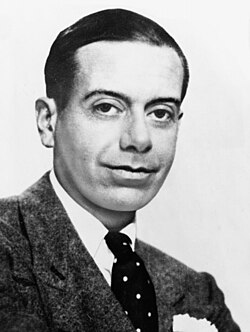
‘Another Op’nin’, Another Show’ comes at the start of the show when the cast of the show within the show are rehearsing for their opening. It was cut from the film version, much to Porter’s annoyance.
‘Brush Up Your Shakespeare’ comes when a group of gangsters (in a subplot about the leading lady’s boyfriend owing them money) are caught on stage and forced to improvise a song about Shakespeare to try and fit in.
‘Wunderbar’ is a nostalgic number sung by the leading lady, Lilli, and her ex-husband, Fred, who is both leading man and producer/director. They recall singing the song when they met as part of the cast of a Viennese operetta.
West Side Story was premiered in 1957 on Broadway and is also Shakespeare-related, being an update of Romeo & Juliet. Originally it was called East Side Story and was about to tensions between Irish Catholics and Jews. By the time its composer, Leonard Bernstein, met Stephen Sondheim and the latter agreed to write the lyrics, it was changed to reflect tensions between Polish Catholics and Puerto Ricans. Apart from anything else, it was a less intractable conflict and Latin music was more danceable. Bernstein was a prodigy as pianist and composer of all kinds of music, both ‘serious’ and ‘popular’. Sondheim was 12 years younger and had written several unproduced musicals: for this one he stuck to the words and it launched his career.
‘America’ comes when the girls associated with the Sharks, the Puerto Rican gang, discuss the pros and cons of their new home.
‘Tonight’ is a duet between Maria, the Puerto Rican heroine, and Tony, the Polish-Irish hero. They sing it together after they have met at a teenage dance intended to bring peace between the factions and instantly – and inconveniently – fallen in love.
‘Somewhere’ is a sad and tender duet between the star-crossed lovers after Tony has been provoked into stabbing Maria’s brother, Bernardo, in an arranged gang ‘rumble’.
Oliver!was premiered in 1960 and was the first successful musical based on a Charles Dickens story. Music, lyrics and book (the script) were all written by Lionel Bart, who started as an amateur wriitng songs for plays and pop acts. He could not read or write music: he hummed the tunes for Oliver! and a professional composer wrote them down. The musical simplifies Dickens’s Oliver Twist and softens the character of Fagin. Both Bart and the man who created the role, Ron Moody, were East End Jews. It was a smash-hit, Bart became famous and rich, but he succumbed to drink and drugs, sold the rights to Max Bygraves for £350 and the only job he got in later life was an advertising jingle for Abbey National.
‘Consider Yourself’ is the song a pickpocket called Artful Dodger uses to lure the innocent runaway Oliver into Fagin’s criminal gang.
‘Where Is Love?’ comes early in the plot, when Oliver, having asked for more food, is sold by the parish official who runs it to an undertaker. He sings it while trying to sleep in a room full of coffins.
‘Food, Glorious Food’ is the rumbustious opening number of the show, sung by the orphan boys, who are permanently hungry. OIiver is moved to make his protest.
The Sound of Music was premiered in 1959. Richard Rodgers wrote the music and Oscar Hammerstein II wrote the lyrics. It was their last musical together and was based on a German book and film about the real Von Trapp family of Austria. Their story was somewhat altered: in reality they escaped by train and not on foot across the mountains. The musical gave rise to a film, with Julie Andrews, that held the record as highest-grossing film of all time for five years.
‘The Sound of Music’ is sung on the hills by Maria, the free-spirited nun, who is clearly not ideal nun material.
‘Do-Re-Mi’ is a music lesson delivered by Maria, new governess to Captain Von Trapp’s children, as a respite from his militaristic discipline.
‘Edelweiss’ is a patriotic number sung by Captain Von Trapp at the family group’s last concert before he is required to head off to a new command in the Nazi-controlled Austrian navy.
‘I Am 60, Going on 70’ is a parody of the original ‘I am 16, Going on 17’, written and performed with apologies to the ghost of Oscar Hammerstein II.
‘Yellow Submarine’ was written by Paul McCartney in 1966 as a ‘double A-side’ with ‘Eleanor Rigby’. He had enjoyed nonsense verse at school and underwater shows were then a staple of television.
‘Michelle’ began when all things French and moody, especially the singing, were popular among John Lennon’s art school friends. McCartney was younger but took his guitar along and did a vaguely Gallic turn. The French-teacher wife of one of McCartney’s schoolfriends gave him ma belle as a rhyme for ‘Michelle’ and told him how to translate ‘these words go together well’.
‘Ev’ry Time We Say Goodbye’ is another Cole Porter song, from a 1944 revue called Seven Lively Arts. It is particularly admired for a lyric comparing the unhappiness caused when lovers separate to the musical change from a major to a minor chord – and a chord sequence that does it. It has been sung by everyone from Ella Fitzgerald and Sarah Vaughan to Rod Stewart and Lady Gaga.
‘Waltzing Matilda’ was written by a solicitor, journalist and poet called A. B. Paterson, who called himself ‘Banjo’ after his favourite horse. The music was borrowed from an English march, but modified somewhat by the amateur pianist who first set the words to the tune. A ‘matilda’ is a bag carried by a ‘swagman’ (an itinerant worker); a ‘billy’ is pot for boiling water; a ‘jumbuck’ is a sheep; a ‘squatter’ is a small landowner and ‘a billabong’ is a watering hole. The song is sometimes called Australia’s national song but attempts to make it the national anthem have been stubbornly resisted because the lifestyle it celebrates is not respectable.
